If You Drive a Corvette We Are Family
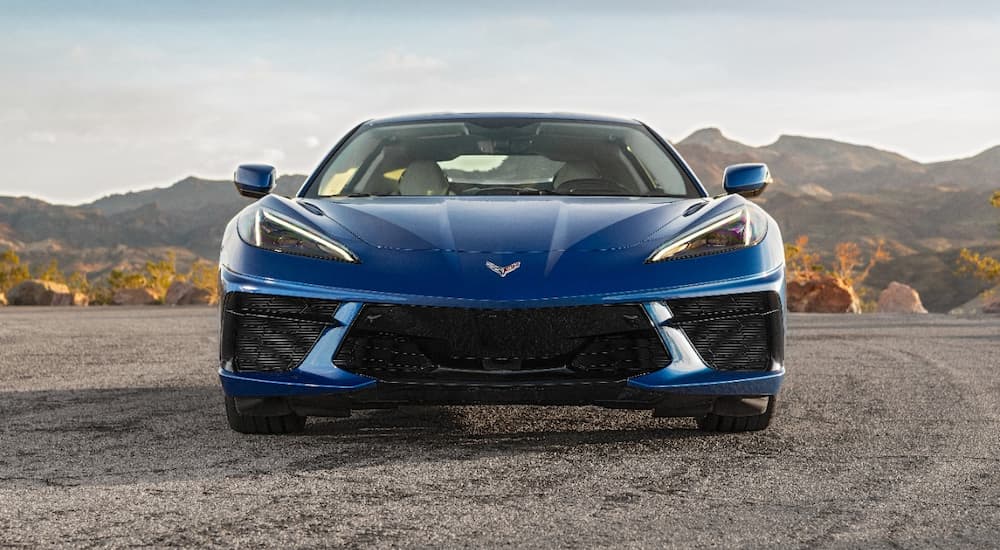
Equally a used Chevy Dealer in Houston, we're here to let you in on a really absurd surreptitious: in that location is no other American sports machine with the lineage and legacy of the Chevy Corvette. For almost seventy years, Chevrolet has been building these astonishing cars, and you can go far on it by buying a used Corvette for yourself. The Chevy Corvette has evolved over eight generations, with the latest version striking the road in 2020 and pointing to a very bright future. Each successive model has built on the success from the previous 1, adding new features, improving upon performance, and featuring caput-turning looks that prepare them apart from other sports cars of their day.
Through each generation of the Corvette, some things have remained consequent. Every model has been rear-wheel drive to boost acceleration, with two doors and two seats. Every Corvette has also featured a front-engine design – that is, until the eighth generation, which became the get-go model to take a mid-engine pattern. If yous want to get your own office of this neat Chevy Corvette legacy, then head over to Parkway Family Chevy. We behave a full lineup of new, used, and certified pre-endemic Chevy vehicles, including an extensive inventory of used Corvettes.
The First Generation: Start of a Legacy (1953-1962)
In the early '50s, Chevrolet decided to start edifice a sports car designed for performance, returning to the origins of the company formed by Will Durant and racecar driver Louis Chevrolet. The determination was made to utilize fiberglass for the body in order to go smoother contours while lightening the overall vehicle weight. The first generation of Corvettes were convertibles but and took their proper noun from the small, agile warships that had been used to help win World State of war 2. The front end and rear bumpers were made of shiny chrome to better accent the styling of this sporty roadster.
Chevy initially equipped the Corvette with a 3.9-liter Bluish Flame I-6 gas engine that produced 150 horsepower paired with an automated transmission. Deciding to increase performance, Chevy began offering the Corvette with a 4.3-liter Small Block V8 engine in 1955, discontinuing the Blue Flame I-half dozen after this model twelvemonth. An available three-speed manual transmission was added as well, which would exist improved to a 4-speed manual manual for the 1957 model year.
Those start Corvettes also featured a solid beam rear pause, something that would be abased in time to come years. In addition, the first-generation Corvette had a torso, which would also disappear until later generations. The looks would modify also, with the Corvette losing its distinctive tailfins in 1956, also the first twelvemonth that Chevy would offer an optional hardtop on its flagship coupe.
The 2nd Generation: Building on Success (1963-1967)
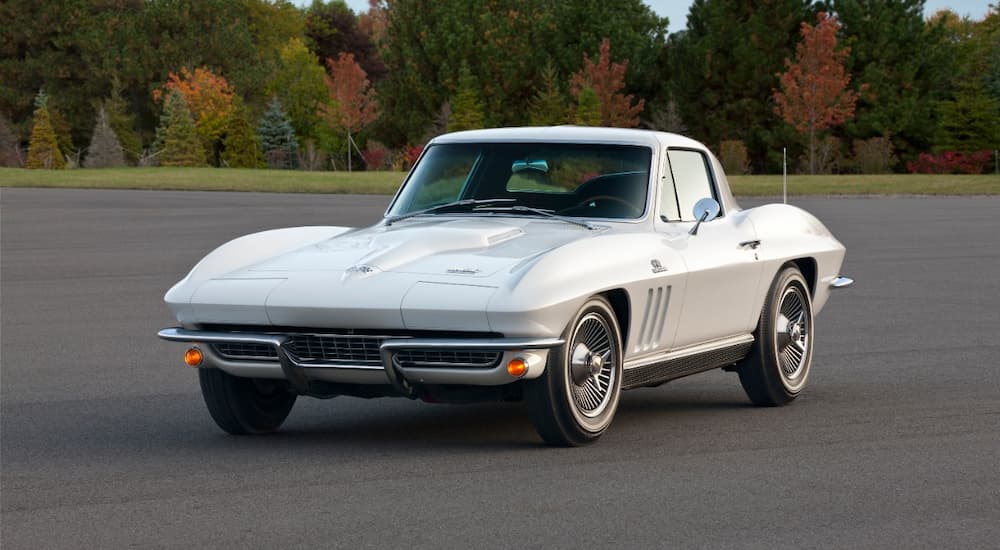
Deciding the times they were a-changing, Chevy made some radical changes to the Corvette for 1963. A hardtop coupe chosen the Sting Ray joined the convertible model, and it featured a rear split up window, something that split opinions amongst Chevy's pattern squad. This would be replaced in 1964 with a full window. The designers took advantage of the malleability of fiberglass to give the second generation a tapered rear roofline. The headlights were recessed into the hood and would pop upward when engaged.
Likewise new was an independent rear suspension, giving the Corvette a smoother overall ride. The featured engine on the 2d generation Corvette was a 5.4-liter Pocket-size Block V8 with 360 horsepower, which would be additional to 375 horsepower for the 1964 model year. Chevy began offering an optional 6.5-liter Big Block V8 with 425 horsepower for the 1965 model yr. This would be replaced in 1966 with a vii.0-liter Big Block V8 also with 425 horsepower. The 1966 and 1967 models with the Big Block V8 would sport a distinctive hood bulge.
The Tertiary Generation: The Longest Running Show (1968-1982)
When 1968 rolled effectually, Chevy decided to redesign the Corvette to capture the styles of the late '60s with a design based on the Mako Shark concept car. One of the about notable style elements was the introduction of removable roof panels on the t-top roof. This would allow those buying the Stingray coupe to get some of the open-air benefits enjoyed by those driving a Corvette convertible. Likewise, they changed the name Sting Ray to Stingray. The tertiary generation continued the retractable headlights first introduced in the 2nd generation.
Chevy continued to offer the Corvette with a option of engines. Where the standard model ran on a v.7-liter Pocket-sized Block V8 with 300 horsepower, the more powerful version sported a 7.4-liter Big Block V8 with 360 horsepower. All the same, Corvettes do not drive in a vacuum, and the increased need for vehicle safety coupled with the rising toll of gas led to a number of changes.
First, the engines on the Corvette began to feature smaller output to both operate on low lead and later unleaded gasoline, as well equally to provide ameliorate fuel economy. As a result, the five.7-liter Pocket-size Block engine went from 300 horsepower and 1968 to 270 horsepower in 1971, and finally only 165 horsepower in 1975. The convertible was also discontinued in 1975 due to lagging sales. In addition, the Big Cake engine was discontinued in 1980. Finally, Chevy had to supersede the Corvette's signature chrome bumpers with urethane-covered ones in order to comply with new federal mandates in 1973.
The Fourth Generation: Back to the Future (1984-1996)
1982 marked the last twelvemonth of the third generation Corvette, and when Chevy failed to release a new model for 1983, some enthusiasts feared this was the cease of the road for Chevy's signature sports car. But those fears were misplaced, and the Corvette came roaring back in 1984 with a full redesign. The fourth generation would testify to exist the 2d-longest run in the storied history of this model, surpassed simply past the third generation.
The most distinctive feature of the quaternary generation Corvette is its hatchback. This was a nod to the need for at least some cargo infinite on the two-seater. The t-superlative roof was replaced past a one-piece Targa tiptop on the Stingray coupe, and lightweight running gear was added to increment operation. However, the car kept the same retractable headlights that starting time popped up in 1968.
As gas prices began to ease during the Eighties, Chevy began increasing the horsepower on the Corvette. The standard 5.7-liter Crossfire V8 that had 205 horsepower in 1984 was replaced by a 300-horsepower LT engine by the terminate of the decade. The fourth generation besides saw the render of the Corvette convertible in 1986 and the debut of the ZR1 loftier-performance model in 1990. This successful generation would proceed to be built until 1996.
The Fifth Generation: Congenital for Speed (1997-2004)
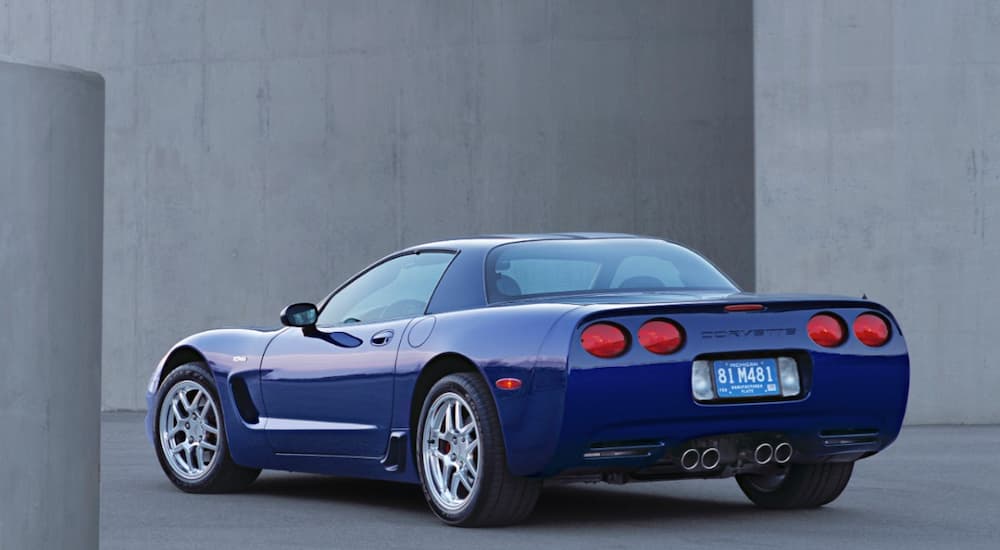
Even though the fifth generation of the Corvette lasted only seven years, a great many strides were made in such a short time. Showtime, the redesigned 1997 model sported hydroformed side frame rails made of a unmarried piece of tubular steel. This not only fabricated the car more aerodynamic but besides improved its structural integrity. I year later on, a hardtop model would join the lineup with permanently fixed roof panels.
1998 was likewise the year that Corvette brought back the trunk that had been missing since the 1962 model concluded the offset generation. Another year to notation is 2004 – the commencement year that Chevy used a carbon cobweb hood on the front end-engine Corvette. This would show a willingness to go with more durable composite materials than the fiberglass that had provided the trunk for the Corvette since its debut.
The other thing that stands out nearly the fifth-generation models is that they were very fast. The engines ranged from the 345-horsepower LS1 aluminum Small Block V8 to the 405-horsepower LS6 V8 in the Z06. The latter model gave the 5th generation a superlative speed of 175 miles per hour, setting a standard for future generations of this sports car.
The Sixth Generation: Bright Eyes (2005-2013)
The first affair you lot are sure to notice about the sixth generation of the Corvette is that Chevy did away with the retractable headlights that had been a distinctive characteristic of the machine since 1968. The 2nd affair you may detect is that information technology has a wider opinion than previous models, giving the driver and passenger more than hip room in the process. Just probably the almost of import modify was something that you lot couldn't see with the naked eye. Chevy began using a full aluminum frame for the Corvette, reducing gross vehicle weight without sacrificing safety. The exterior was however made of fiberglass, merely the aluminum frame supported information technology without adding too much to the car's weight. As a result, the sixth-generation model blew by all prior models of the car.
The standard engine on the 6th-generation Corvette is a vi.0-liter V8 with 400 horsepower and 400 lb-ft of torque. Those are numbers that eclipse almost every prior model of the Corvette, and that is merely the base of operations engine. The 6.two-liter LS3 V8 was introduced in 2008, producing 430 horsepower and 424 lb-ft of torque, with a top speed of 190 miles per hour. The 7.0-liter LS7 in the Z06 has 505 horsepower and can go 0 to 60 mph in simply iii.vii seconds with a height speed of 198 miles per hour. But the accented champion for speed demons is the half-dozen.2-liter LS9 supercharged V8 on the ZR1 model with 638 horsepower and 604 lb-ft of torque. The 6th-generation Corvette ZR1 has a peak speed of 205 miles per hour, making it the fastest Corvette model always built.
The 7th Generation: Final of the Front-Engine Models (2014-2019)
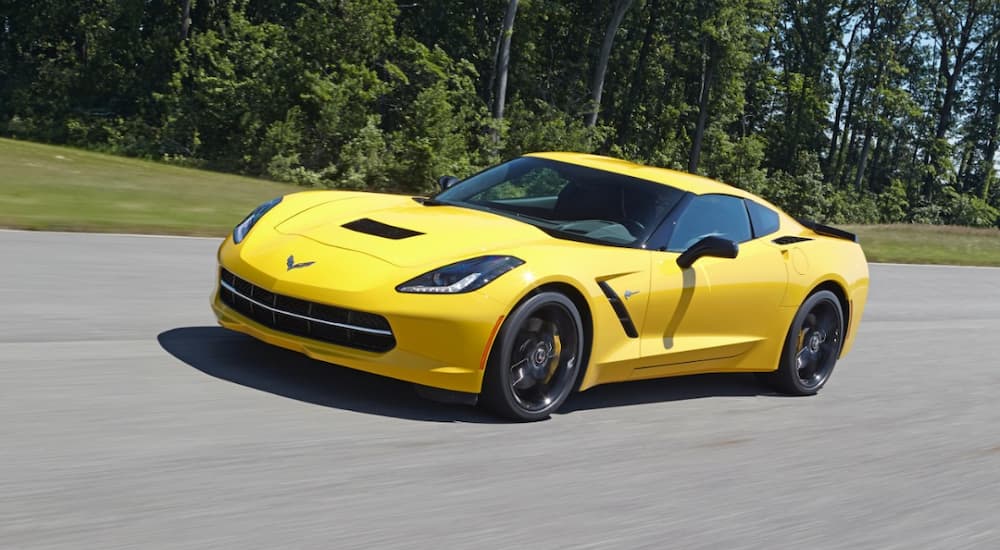
The seventh generation of the Corvette was the final to employ a front end-engine blueprint. This model connected the use of an aluminum frame but used carbon-nano blended for the underbody, as well carbon fiber for the hood and roof panels. The design is sleeker than whatever prior model, with a more streamlined stance than the sixth-generation model. This is the upshot of using more than composite materials in the design than the prior fiberglass models.
Chevy began offering the Corvette with a choice of a 7-speed manual transmission or a 6-speed automatic with paddle shifters. The latter gives drivers the control associated with a manual transmission without the hassle of working a clutch. This would prove to be a popular feature. Chevy likewise continued the tradition of offering several engine options on the Corvette.
The standard engine is a 6.2-liter LT1 Small Block V8 with 455 horsepower and 460 lb-ft of torque that tin be increased to 460 horsepower and 465 lb-ft with an optional performance exhaust. The Z06 model sports a 6.2-liter LT4 V8 with 650 horsepower and 650 lb-ft torque, while the ZR1 has a 6.2-liter LT5 supercharged V8 capable of 755 horsepower and 715 lb-ft of torque. The seventh generation of the Corvette ZR1 ready the mark for quickest acceleration on the model, going from 0 to 60 mph in under 3 seconds. Long gone were the days of the underpowered Corvettes of the '70s fuel crisis.
The Eighth Generation: To Infinity and Beyond (2020-nowadays)
Chevrolet turned many heads when it announced that its eighth generation of the Corvette would be the get-go mid-engine model in the motorcar's history. The current version of the Corvette gives drivers the performance, handling, and looks associated with European supercars at a fraction of the cost. Drivers tin choose from a coupe or convertible, with each featuring a 6.two-liter LT2 V8 with up to 495 horsepower and 470 lb-ft of torque. While this engine is simply slightly more than powerful than the standard LT1 Small-scale Block V8 on the seventh-generation Corvette, the mid-engine motorcar more than than matches the functioning of the prior generation's top ZR1 model. Paired with an 8-speed dual-clutch manual with paddle shifters, the 8th generation Corvette tin go from 0 to lx mph in only 2.9 seconds with a peak speed of 194 miles per hour. This is the result of the lighter frame, the lower profile, and the rear weight distribution associated with a mid-engine design.
The Time to come of the Corvette
Chevrolet has built an astonishing legacy over the near 70 years of the Corvette. From a standard convertible with an I-6 engine to a mid-engine supercar, the Corvette has gone through all the phases and innovations associated with a sports car, leading the way in performance and design. As for the future, we may run into an electric Corvette in the future, as EV functioning continues to improve. Of course, there are those of the states who will miss the rumble and roar of a gas engine. We may besides see the Corvette add together a rear seat, although this will be an even bigger suspension with tradition than a mid-engine blueprint. Even so, whichever direction Chevy takes, we are sure to run across Corvette leading the way for another 70 years. You tin can become a part of this legacy by making a used Corvette your next purchase. Whichever generation you choose, yous are sure to find that nix matches the performance and enjoyment of this great sports car.
Write a comment
lemonsdoormemas1978.blogspot.com
Source: https://www.parkwaychevrolet.com/blogs/3415/its-all-in-the-family-with-8-generations-of-corvette/
0 Response to "If You Drive a Corvette We Are Family"
Postar um comentário